
Big Sur
The Deep History and Modern Discovery of Big Sur Jade
The story of this stone began over 300 million years ago, born from the chaotic subduction zones along what is now the California coast. Deep within the Earth, the Pacific Plate plunged beneath the North American Plate, creating a high-pressure, high-temperature furnace that transformed oceanic crust and continental sediments into the Franciscan Complex. Within this unique “mélange” of rocks, nephrite jade formed in rare, lens-like pockets surrounded by serpentine. Over eons, tectonic uplift thrust these deep-sea minerals into the rugged Santa Lucia Mountains. Today, Big Sur is home to the world’s only documented concentrated underwater deposit of quality nephrite, as the relentless Pacific Ocean erodes these mountain veins directly into the sea.
Long before the term “Big Sur” was coined, indigenous peoples—including the Chumash and Esselen—were the stone’s first caretakers. They revered jade for its incredible durability and a unique physical property: heat retention. Artifacts found at coastal archaeological sites show that tribes would heat jade stones to a “cherry red” glow and drop them into acorn soup or use them as efficient bed-warmers. While it was long believed these tribes didn’t have a carving culture, recent discoveries—including a monumental jade pestle found in Santa Barbara County—suggest that ancient artisans spent thousands of hours “peck-carving” ceremonial objects from the stone.
The modern era of Big Sur jade began in the early 1940s, gaining national momentum after World War II and the completion of Highway 1. By the 1950s and 60s, a new breed of adventurer emerged: the skin diver. Exploring the kelp forests and tide pools of Jade Cove, early pioneers like Ernie Porter began the difficult work of extracting massive boulders from the seafloor. These divers operated in a “wild west” environment before modern conservation laws, often using primitive gear to recover stones that had been naturally polished by the ocean’s “sand-pelting” for centuries.
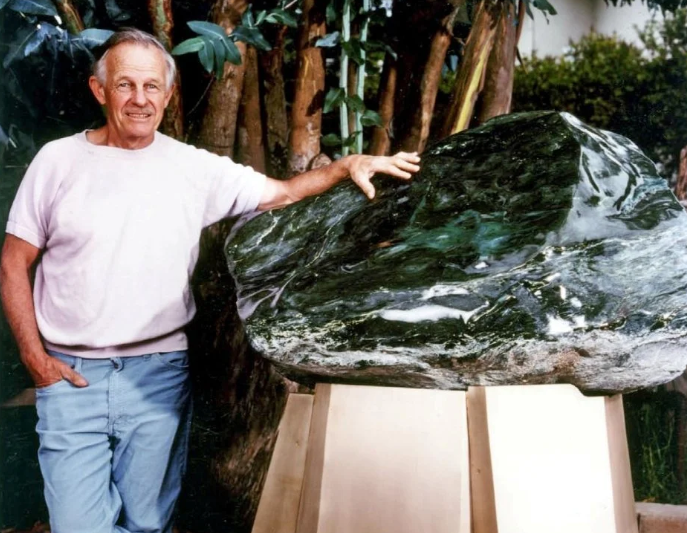
No name is more synonymous with Big Sur jade than Don Wobber, a marine biologist and sculptor who became a legend of the cove. Wobber’s crowning achievement occurred in 1971 when he and his crew discovered a massive, 9,000-pound monolith they named “The Nephripod”. Over eight months, they used inflatable pontoons, wire mesh nets, and “underwater elbow grease” to float the giant stone to the surface. Wobber’s odyssey, documented in his 1975 book Jade Beneath the Sea, culminated in parading the stone through San Francisco’s Chinatown before it found a permanent home at the Oakland Museum of California. Wobber’s work and philosophy—viewing jade diving as a journey into the subconscious—helped spark the global prominence of Big Sur jade as one of the rarest gems on earth.
The Big Sur Jade and Monterey Bay Jade Festival
Excessive commercial harvesting in the 1970s eventually led to a moratorium and strict regulations in the early 1980s, ending the era of giant boulder extraction. Today, the culture is sustained by a dedicated niche of artists and “rockhounds”. This community gathers every October for the Big Sur Jade Festival, where master carvers showcase contemporary work that bridges ancient traditions with modern conservation. Every June in the city of Monterey, you can attend the Monterey Bay Jade Festival. The MBJF hosts a jade summit, where you can learn different aspects about jade by some of the top leaders in the jade industry. These festivals remain a vital hub for educating the public on the stone’s history, ensuring that the legend of the “Jade Beneath the Sea” continues for future generations.
The Spiritual Essence and Grounding Energy of Big Sur Jade
In the metaphysical world, Big Sur Nephrite is considered one of the most powerful grounding stones available to modern practitioners. While many jades are associated purely with the earth, Big Sur jade carries a dual signature. Because it was forged in the volcanic fires of the tectonic plate boundary and then spent thousands of years being battered by the cold, oxygen-rich currents of the Pacific Ocean, it is believed to balance the “Fire” of the soul with the “Water” of the emotions. Spiritualists often refer to it as a Stone of Serenity, capable of helping the wearer navigate “stormy seas” in their personal lives. It is said to act like an anchor; just as a jade boulder sits unmoved by the crashing surf of Jade Cove, the person wearing the stone is granted the strength to remain centered and calm during periods of intense emotional or professional upheaval.
Unlike the “warrior energy” often associated with New Zealand’s Pounamu weapons, Big Sur jade is frequently viewed as a Healer’s Stone. It is common for practitioners to place a piece of ocean-polished jade on the body during meditation to draw out “heat” (inflammation or anger) and replace it with the cool, rhythmic stability of the Monterey coastline. This “nurturing” aspect is why many people choose Big Sur jade as a gift for those recovering from illness or undergoing major life transitions.
For many who visit the rugged cliffs of the Santa Lucia Mountains, Big Sur jade serves as a physical bridge to the Wilderness Spirit. There is a long-standing belief among local “Jade Rats” (the affectionate term for dedicated coastal hunters) that the stone has a way of “choosing” its owner. Many hunters report a sense of “magnetic pull” or a sudden intuitive “ping” just before they spot a green glint among the grey cobbles. This is seen as a sign of being in alignment with the natural world. Wearing a piece of Big Sur jade is thought to sharpen one’s intuition and deepen their connection to the environment. For those living in high-stress, urban environments, the stone acts as a “pocket-sized wilderness,” providing a tactile reminder of the vast, ancient, and unshakeable power of the California coast. It is a stone for those who seek to harmonize their modern lives with the primordial pulse of the earth.
Beyond its protective qualities, Big Sur jade is widely regarded as a Stone of Abundance. In various traditions, green stones have been used to attract prosperity, but the specific “ocean-cleansed” nature of Big Sur jade adds a layer of “flow.” It is believed to help the wearer release stagnant thoughts and “clogs” in their creative energy, allowing new opportunities to wash in like the tide. Because the stone is so difficult to find and requires such effort to recover from the depths of the sea, it is also a symbol of reward for perseverance. It teaches the spiritual lesson that true treasures are often hidden beneath the surface and require patience, courage, and a willingness to “dive deep” into one’s own subconscious to be realized. Many entrepreneurs and artists keep a piece of Big Sur jade on their desks to maintain a steady flow of creative “Mauri” (life force) and to attract the “luck of the cove” into their ventures.
Where and How is Big Sur Jade Found
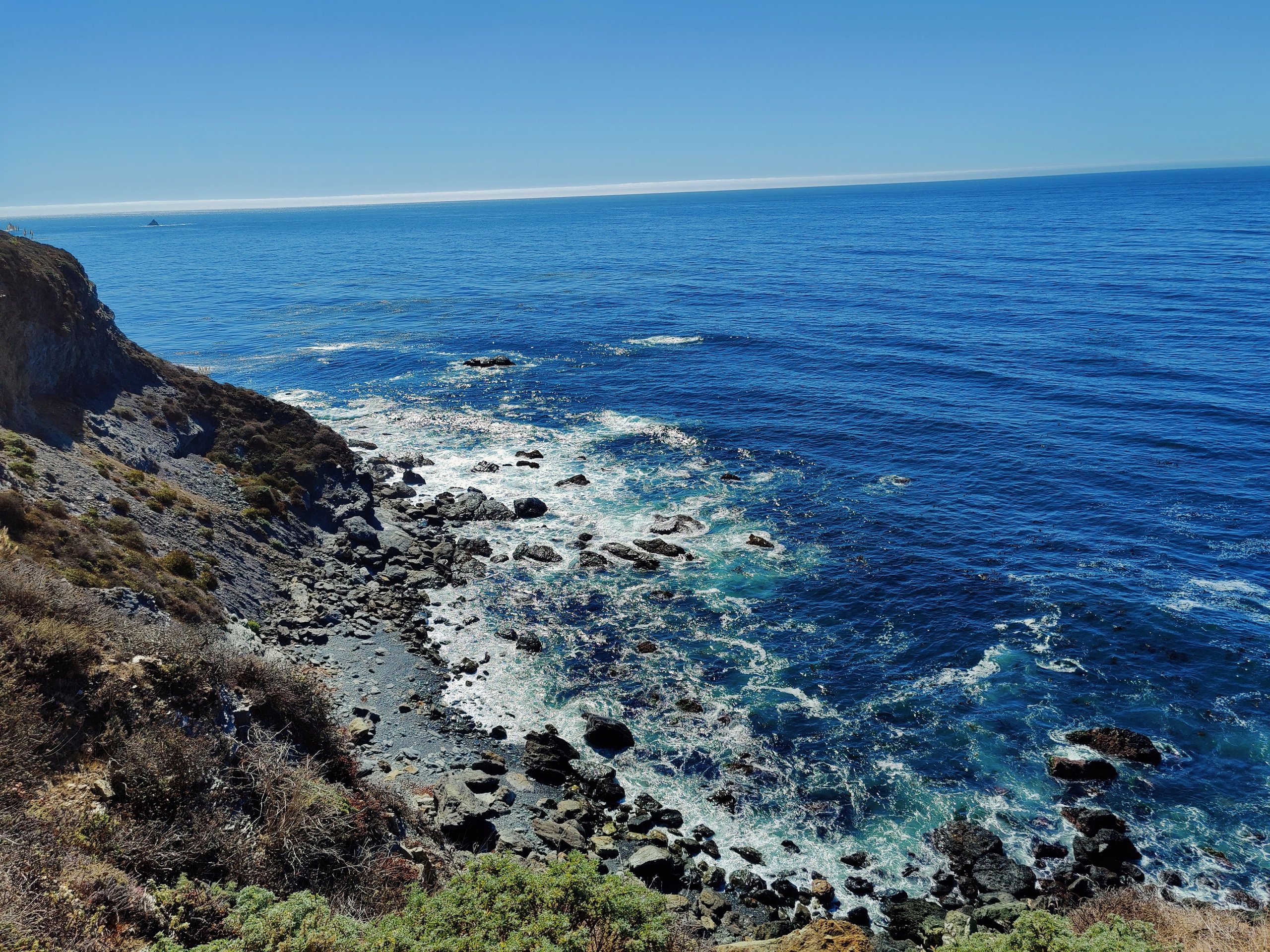
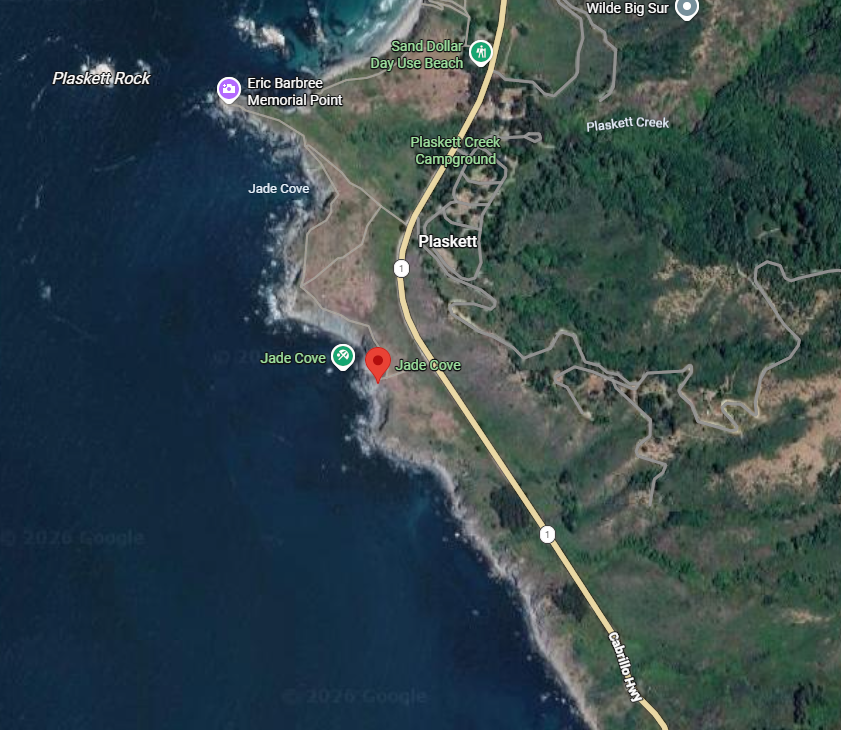
Big Sur jade is found along a remarkably narrow and rugged stretch of the Monterey County coastline, centered primarily within the Los Padres National Forest. While small amounts of nephrite can be found scattered across various “secret” spots along the Santa Lucia range, the world-famous “Mother Lode” is concentrated in a three-mile stretch known as Jade Cove. Located about 65 miles south of Monterey and 30 miles north of San Simeon, this area is a geological anomaly. Unlike the river-born Pounamu of New Zealand, Big Sur jade is primarily an underwater deposit. The jade exists in massive veins that run beneath the seafloor and out into the kelp forests. Over thousands of years, the relentless power of the Pacific’s winter swells—some of the most powerful on the West Coast—breaks off chunks of these submerged veins and tumbles them into the rocky coves.
The “Jade Coast” is divided into three distinct areas, each with its own personality and difficulty level. North Cove is the most accessible but also the most picked-over; it is where casual visitors often find small pebbles of “botryoidal” jade (jade that looks like a bunch of grapes) or sea-polished “bubbles.” Middle Cove is a steep, treacherous descent involving a narrow trail that clings to the cliffside. It is here that the ocean often “spits out” larger pieces after a heavy storm. South Cove is the most remote and requires a significant hike, making it the favorite for dedicated “Jade Rats.” Beyond the coves themselves, jade can also be found at Sand Dollar Beach, where the stones are often smaller and perfectly rounded by the surf, making them ideal for “worry stones” or simple wire-wrapped jewelry.
Because Big Sur jade is located within the Monterey Bay National Marine Sanctuary, the rules for collection are incredibly strict and strictly enforced. According to federal law, you are only allowed to collect jade from the “Mean High Tide” line down into the water. This means you cannot legally take a stone that is sitting on the dry sand or tucked into the cliffs above the reach of the waves. Furthermore, you are limited to what you can physically carry out by hand. No wheelbarrows, no winches, and absolutely no power tools or hammers are allowed. These laws were put in place in the early 1980s to stop industrial-scale mining and ensure that the beauty of the cove is preserved for everyone. For the average visitor, this means the hunt is a test of strength and endurance—if you find a 50-pound boulder, you have to be able to carry that 50 pounds up a 200-foot vertical cliff on your back!
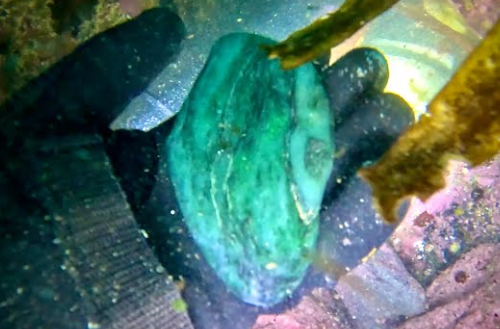
For the most adventurous, the “real” jade is still found beneath the surface. Scuba diving for jade in Big Sur is not for the faint of heart. The water is bone-chillingly cold (averaging 50-55°F), the visibility is often less than five feet due to “marine snow,” and the surge can slam a diver against a jagged rock in seconds. Divers must navigate through thick “forests” of bull kelp to find the “blue-green” glint of a jade vein. Under current regulations, divers are allowed to use small lift bags (up to 200 lbs capacity) to bring a stone to the surface, but they must still manually move the stone to the shore. This underwater world is a silent, emerald cathedral where some of the largest jade boulders on Earth still sit, anchored to the seabed, waiting for a storm powerful enough to set them free.
Identification — Distinguishing Jade from "California Fake"
The greatest challenge for any Big Sur beachcomber is distinguishing genuine nephrite jade from serpentine, which is California’s state rock and is found in massive quantities along the same coastline. To the untrained eye, a wet piece of serpentine can look like a world-class emerald. However, the difference lies in the “soul” of the stone. Serpentine is a magnesium silicate that is relatively soft and “greasy” to the touch. Because it is porous and less dense, it lacks the “weight” of jade. If you pick up two stones of equal size and one feels significantly heavier and “solid” like a piece of lead, you are likely holding nephrite. If the stone feels “light” or slightly soapy, it is almost certainly serpentine.
Because Big Sur jade is often dark olive, deep forest green, or even “black,” you need a powerful light source to see its true identity. When you hold a high-intensity LED torch directly against the stone, genuine Big Sur nephrite will reveal a translucent green glow. However, the type of glow is the key. Look for a “matted” or “cloudy” internal structure. Because of its interlocking fibers, the light will appear to spread out softly inside the stone, like light passing through thick milk. If the light passes through and reveals a “grainy” or “sandy” texture, or if it looks perfectly clear like a green bottle, it is likely Green Jasper or glass. Jasper is very common in Big Sur; it is beautiful, but it is a microcrystalline quartz, not jade, and it will lack that “waxy” depth when polished.
The hardness test is the ultimate “moment of truth” for a Big Sur stone. Nephrite jade is incredibly hard—6.5 on the Mohs scale—making it harder than a standard steel knife. Serpentine, on the other hand, is quite soft (usually 3 to 5). If you find a stone you believe is jade, find an inconspicuous spot on the back and try to scratch it with a stainless steel needle or a sharp pocketknife. If the blade glides off the surface without leaving a mark, or if the metal of the knife actually rubs off onto the stone (leaving a grey metallic line), you have found jade. If the knife digs in and leaves a white, chalky scratch, it is serpentine. Experienced “Jade Rats” often do this test on the beach before they commit to lugging a heavy boulder up the 200-foot cliffs.
One of the most unique and sought-after forms of jade in the world is found specifically in Big Sur is Botryoidal Nephrite. Often called “Bubble Jade” or “Grapes,” this form of jade grows in rounded, bubbly clusters rather than flat veins. It looks like a bunch of tiny green grapes or sea-foam frozen in time. Identification of botryoidal jade is usually easier because of its distinct “bumpy” texture, but “California Fake” versions exist in the form of botryoidal chalcedony. The difference again is the Waxy Luster. Genuine Big Sur bubble jade has a soft, candle-wax appearance, whereas chalcedony will look “glassy” or “shiny.” If you find a piece of botryoidal jade in the cove, you have found one of the rarest geological treasures in the United States.
The Lapidary Art of Big Sur Jade
Working with Big Sur nephrite jade is fundamentally different from carving traditional gemstones like quartz or agate. Because it is a metamorphic rock composed of millions of microscopic, felted fibers, it possesses a structural “toughness” that defies standard lapidary rules. You cannot “chip” or “flake” Big Sur jade; if you hit it with a chisel, the energy of the blow is absorbed by the fibrous weave, often resulting in a “bruise”—a white, shattered internal area that ruins the stone’s transparency.
To work this material, the artist must use abrasive reduction. Every curve, hole, and polish is achieved by slowly grinding the stone away using diamond-encrusted tools. Because it is harder than steel (6.5 on the Mohs scale), the artist is in a constant battle with friction. Modern masters like Justin Barrett and Mathew Glasby have perfected this dance, using constant water cooling to prevent the stone from “burning,” which can permanently alter the chemical color of the jade or delaminate the fibers of the stone.
The journey from a raw, crusty beach boulder to a shimmering masterpiece begins with the “slabbing” process. Big Sur jade found in the surf often develops a thick, weathered “rind”—a grey or tan crust caused by centuries of saltwater exposure and oxidation. The lapidary artist must use a large diamond-tipped saw to slice through this crust to see the “heart” of the stone. This is the ultimate moment of truth; a boulder that looks like a world-class emerald on the outside may be riddled with internal fractures or “dead” spots of black magnetite. Once a clean slab is achieved, the artist must study the light. They look for the “glow” and the grain, deciding how to orient the cut to maximize the stone’s natural translucency. This stage requires a visionary’s eye; you are looking for the art that is already trapped inside the geological chaos.
Once a slab is selected, the “pre-forming” stage begins. Using coarse-grit diamond grinding wheels (usually 80 to 180 grit), the artist grinds away the excess stone to establish the basic silhouette. This is loud, dirty work that produces a thick “jade mud.” After the rough shape is established, the carver moves to smaller, high-speed rotary tools. This is where technical mastery separates the hobbyist from the professional. Using diamond tipped rotary burrs, the artist etches the fine details. To achieve the legendary “organic” look of Big Sur carvings, the artist must maintain a steady hand, even at 50,000 RPMs. A single slip can destroy hours of work. It is in this phase that carvers like Shane Zach or Marco Mazza showcase their skill, navigating the stone’s “toughness” to create curves so smooth they look as though they were melted into shape rather than ground.
The final, and perhaps most difficult, phase is the polishing. A piece of jade straight from the carving burr is dull and covered in microscopic scratches. To reveal the deep, “oceanic” green, the artist must move the stone through a grueling series of sanding stages. Starting with 220 grit and moving progressively to 600, 1200, and finally 3000 grit diamond pads, the artist must remove every single trace of the previous stage’s scratches. If a single 220-grit scratch remains when you get to the polish, it will stand out like a scar. The “Big Sur Style” often favors a soft, waxy lustre over a hard, glassy shine. This is traditionally achieved using Chrome Oxide or a specialized compound called Zam on a felt or leather buffing wheel. This final step brings the stone “to life,” revealing a depth of color and a “soapy” tactile feel that makes the stone impossible to put down.
In a world of mass-produced, factory-carved jewelry, the community of lapidary artists remains one of the last true “hand-wrought” crafts. Each piece is a unique collaboration between the tectonic history of the California coast and the individual soul of the carver. Because no two boulders are identical in their fiber structure or color inclusions, no two carvings can ever be the same. When you hold a finished piece of Big Sur jade, you are holding the result of hundreds of hours of physical labor—from the diver who swam through the kelp forests to the artist who spent days at the grinding wheel. It is a legacy of perseverance, a marriage of human creativity and geological immortality that ensures these stones will be cherished as heirlooms for centuries to come.