
British Columbian Nephrite
The History of BC Jade
The human narrative of jade in British Columbia is a saga of survival, colonial rediscovery, and modern industrial triumph that spans nearly four millennia. Long before the concept of “Canada” existed, the First Nations peoples of the Pacific Northwest—including the Salish, Haida, and Tsimshian—had already mastered the complex lithic technology required to utilize the “tough stone” of the mountains. To these indigenous groups, nephrite was not a decorative luxury but a vital material for survival in a rugged landscape. They harvested water-worn boulders from the gravel bars of the Fraser and Bridge Rivers, utilizing the stone’s incredible resistance to fracturing to create “celts” (ax heads), adzes for dugout canoes, and chisels for totem carving. This “Jade Road” of the West was a sophisticated trade network; BC nephrite artifacts have been found thousands of miles from their source, appearing in archaeological sites across the Great Plains and as far south as the American Southwest, proving that the stone was a high-value currency long before the first European fur traders arrived.
The “modern” history of BC jade took a dramatic turn during the mid-19th century gold rushes. As thousands of prospectors flooded the Fraser Canyon in search of gold, Chinese miners—many of whom had immigrated to work on the Canadian Pacific Railway—recognized the heavy green boulders being discarded as “waste rock” by the gold seekers. Having a deep cultural reverence for jade, these miners began secretly shipping these boulders back to China, where the quality of the “New World” nephrite was immediately recognized as superior for large-scale carvings. This “ghost trade” continued for decades until the 1960s, when Western entrepreneurs finally realized that the green rocks of the Cassiar and Dease Lake regions were a geological treasure in their own right. This led to a “Jade Rush” that saw men like Bill Huff and the founders of Jade West venture into the high alpine wilderness with nothing but horses and dynamite, attempting to pack out ton-sized boulders from some of the most inaccessible terrain on Earth.
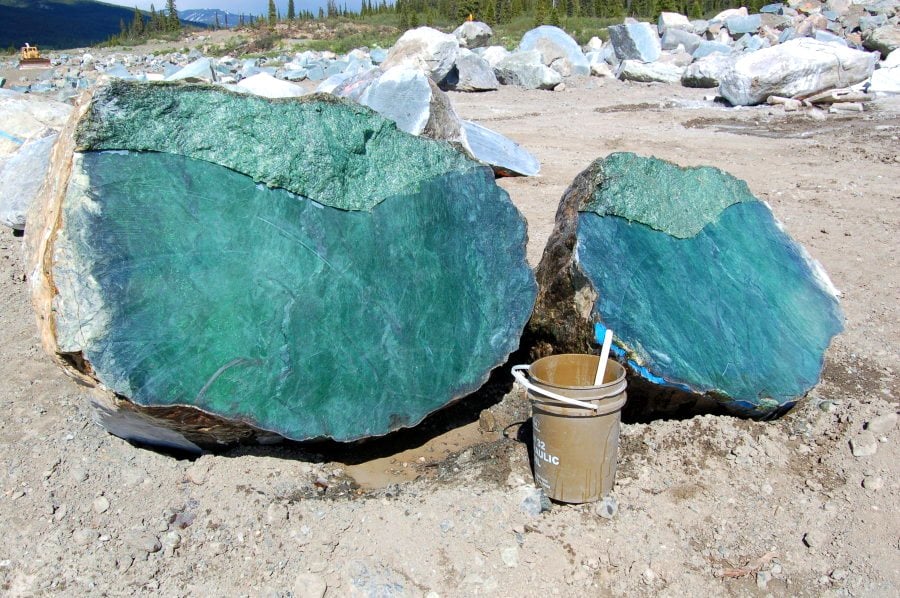
The industrialization of the BC jade industry in the late 20th century changed the global market forever. No longer was jade just a river-found curiosity; it became a massive bedrock mining operation. Companies began using heavy machinery, diamond-wire saws, and helicopters to extract massive lenses of nephrite from the sides of mountains at elevations where the mining season only lasts 90 days. This era saw the discovery of the “Polar Pride” boulder in 1996—an 18-ton monolith of near-translucent green jade that was valued at millions of dollars. This single stone was eventually carved into the “Jade Buddha for Universal Peace,” which traveled the world as a symbol of global harmony. Today, British Columbia is the “Jade Capital of the World,” producing over 400 tonnes of nephrite annually, most of which is exported to satisfy the insatiable demand in China, where “Canadian Green” is now the gold standard for high-end jade sculpture.
Beyond the mining, the cultural legacy of BC jade has become a cornerstone of regional identity. Towns like Jade City on the Stewart-Cassiar Highway have become world-famous tourist destinations, immortalized in television and documentaries that showcase the grit and determination required to harvest the stone. The history of BC jade is a story of transition—from the ancient “celt” used to build a cedar longhouse to the high-tech diamond saws that slice through 20-ton boulders. It represents the meeting of two worlds: the ancient indigenous knowledge of the land and the modern industrial hunger for rare materials. For the lapidary artist, the history of this stone provides a layer of “provenance” that adds immense value to every carving, as it carries the spirit of the high alpine tundra and the rushing glacial rivers of the North.
Spiritual Beliefs and the "Stone of the North"
While British Columbia jade is often associated with industrial-scale mining, its spiritual footprint is deeply rooted in the concept of “Earth Medicine.” Because the stone is formed under the intense pressure of the Rocky Mountains and then “cleansed” by the freezing, pure waters of glacial rivers, it is believed to carry a unique vibration of resilience and endurance. In modern metaphysical circles, BC nephrite is celebrated as a premier “Stone of the North,” representing the ability to thrive in harsh environments. It is often used by those seeking to build inner strength and “mental toughness.” Just as the jade boulder survives the crushing weight of a glacier, the person carrying BC jade is said to be granted the spiritual fortitude to remain unbroken by the stresses of modern life. It is viewed as a “life-long companion” stone, one that doesn’t provide a quick fix but rather builds a steady, unshakeable foundation of peace and stability.
In the context of the Heart Chakra, BC jade is considered one of the most powerful “Healers of the Heart.” Its deep, moss-green color is thought to resonate with the rhythms of the natural world, helping to align the wearer’s heartbeat with the pulse of the forest. Spiritual practitioners use BC jade to release “clogs” in the emotional body—specifically feelings of guilt, resentment, or the fear of poverty. It is a stone of abundance, but not in a greedy sense; rather, it promotes the belief that the Earth is naturally bountiful and that one’s needs will always be met if they remain in harmony with nature. This “prosperity mindset” is a key reason why BC jade is so popular among those starting new businesses or making major life changes. It provides the “green light” energy needed to move forward with confidence and clarity.
The indigenous spiritual connection to the stone adds another layer of meaning. To many First Nations peoples, the stone was a gift from the Earth Mother, a physical manifestation of her strength. It was often used in “potlatch” ceremonies as a symbol of high status and a bridge between the physical and spirit worlds. There is a widespread belief that the stone acts as a Guardian of the Home. When a large piece of raw BC jade is placed near an entrance, it is said to “filter” the energy coming into the space, trapping negativity and allowing only “clean” Mauri (life force) to enter. This belief has transitioned into the modern world, where many people keep small “river-worn” BC jade pebbles in their pockets as “worry stones,” rubbing them to discharge nervous energy back into the earth.
Furthermore, BC jade is often linked to the concept of “Spiritual Longevity.” Because nephrite is virtually indestructible and does not degrade over time, it is seen as a physical anchor for the soul. It is believed that the stone can “hold” prayers and intentions, acting as a spiritual hard drive that keeps the wearer focused on their long-term goals. In the high-stakes world of the Northern mines, there is a legendary “luck” associated with the stone; miners often speak of the stone “calling” to them or “revealing” itself when they are in a state of high intuition. This relationship between the seeker and the stone creates a spiritual bond that is unique to the BC wilderness. Whether you are wearing a polished bead or holding a raw river cobble, BC jade is thought to provide a direct link to the vast, untamed spirit of the Canadian wild, offering a sense of protection that is as solid as the mountains themselves.
Where BC Jade is Found — The Cordilleran Belt
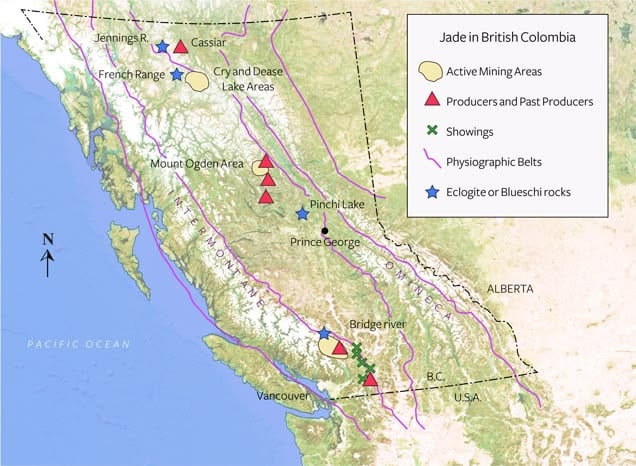
The geological “home” of British Columbia jade is a massive, north-northwest trending belt of ultramafic rocks that stretches for over 1,000 miles, from the U.S. border all the way to the Yukon. This belt follows the Cordilleran Mountain chain, where ancient oceanic crust was pushed onto the continental margin during the collision of tectonic plates millions of years ago. Within this vast corridor, there are three primary mining “clusters” that have defined the industry for the last 50 years: the Southern, Central, and Northern clusters. Each of these regions offers a different environment for the hunter, ranging from accessible riverbanks in the south to high-altitude alpine peaks in the north that are only reachable by helicopter for a few weeks each summer.
The Northern Cluster, located near the Yukon border, is the undisputed heavyweight champion of the jade world. This region includes the famous Cassiar, Dease Lake, and Cry Lake areas. The most legendary mine in this cluster is the Polar Mine, situated near Dease Lake, which produced the world-famous “Polar Jade”—a variety known for its intense, bright green color and rare translucency. Mining here is an extreme endeavor; the terrain is so rugged and the winters so long that the mining season is often limited to just 60 to 90 days between July and September. Most of the jade found here is in the form of “in situ” lodes—veins of jade still trapped in the bedrock—or massive “float” boulders that were pushed down from the peaks by retreating glaciers during the last Ice Age.
The Central Cluster is dominated by the Mount Ogden area, located northwest of Prince George. This region is home to several active mines that produce a wide variety of “commercial grade” stone, typically used for larger sculptures and tiles. Mount Ogden is particularly significant because it contains some of the largest documented “lenses” of nephrite in BC, often appearing as cigar-shaped pods tucked into the contacts between serpentinite and more silica-rich rocks. Because this area is slightly less remote than the Cassiar, it has been a consistent producer of jade for decades, serving as the backbone of the Canadian export market.
The Southern Cluster represents the historical heart of the BC jade trade, centered around the Fraser River, Lillooet, and Bridge River areas. This is where the story of BC jade began for the First Nations peoples, who harvested “placer” boulders—stones that had been naturally washed down from the mountains and deposited on the river gravel bars. Even today, “rockhounds” visit the Fraser River after spring floods, hoping to find a newly unearthed jade cobble that has been naturally tumbled and polished by the rushing water. While the large industrial mines have shifted north, the Southern Cluster remains the most accessible place for a visitor to see the stone in its natural “river-worn” state.
Identification — Forensic Testing for BC Jade
Identifying genuine British Columbia nephrite in a market flooded with “California Fake” or serpentine requires a disciplined, multi-step forensic approach. The primary challenge is that BC jade only exists in one color: Green. While it can range from a pale “sage” to a deep “midnight” forest green, it will always show a green hue when held to a powerful light. If you have a piece that claims to be “White BC Jade,” be warned: while some silonite from the Fraser River is nicknamed “mutton fat,” it is not true nephrite. Genuine identification begins with the Specific Gravity (SG) Test, which is the most reliable way to separate nephrite from its less-dense cousins. BC nephrite has a very specific density of 2.90 to 3.03. By weighing the stone in air and then again while submerged in water, you can calculate its density; if the number is significantly lower than 2.9, you are likely holding serpentine or green quartz.
The second line of defense is the Mohs Hardness Test. BC nephrite is “hard as steel,” rating between 6.0 and 6.5 on the Mohs scale. This means a standard stainless steel knife or a copper coin should not be able to leave a permanent scratch on the surface of the jade. To perform this test safely, find an inconspicuous spot on the back of the stone and apply firm pressure with a steel needle. If the needle leaves a white, chalky line that can be wiped away, it was simply metal residue from the needle; if it leaves a physical groove in the stone, it is Serpentine (which has a hardness of only 3 to 5). Be cautious of “Green Jasper,” which is actually harder than jade (7.0), but can be identified by its blocky, opaque appearance and lack of the “waxy” lustre that defines true nephrite.
The Visual and Translucency Test is where the artist’s eye meets the geologist’s tool. Using a high-intensity LED penlight, hold the beam directly against the stone. In genuine BC jade, the light should travel into the stone, revealing a “felted” or “fibrous” internal world. Because nephrite is made of tiny, interlocking actinolite-tremolite fibers, the light will look “cloudy” or matted. If you see tiny, perfectly round air bubbles, it is glass. If you see bright, “sparkly” crystalline flakes, it is likely Aventurine Quartz, often sold as “Indian Jade”. Also, look for the “black spots”—nearly all BC jade contains tiny specks of chromite or magnetite. In BC stone, these spots are usually distinct and well-distributed, unlike the “lizard skin” network of dark lines common in serpentine.
Finally, there is the Auditory and Tactile Test, often used by “old-timers” on the riverbanks. Because of its extreme density and interlocking structure, jade has unique acoustic properties. If you gently tap two unmounted pieces of BC jade together, they should produce a clear, musical, and high-pitched “clink” rather than a dull, plastic “thud”. Tactilely, the stone should feel ice-cold to the touch and remain cold for a several seconds even after you’ve held it in your warm palm. It should have a waxy or “greasy” luster, feeling almost like a hard bar of soap. If it feels “glassy” and warms up to your hand temperature immediately, it is likely a synthetic or resin-based imitation.
The Lapidary Art and Carving of British Columbia Jade
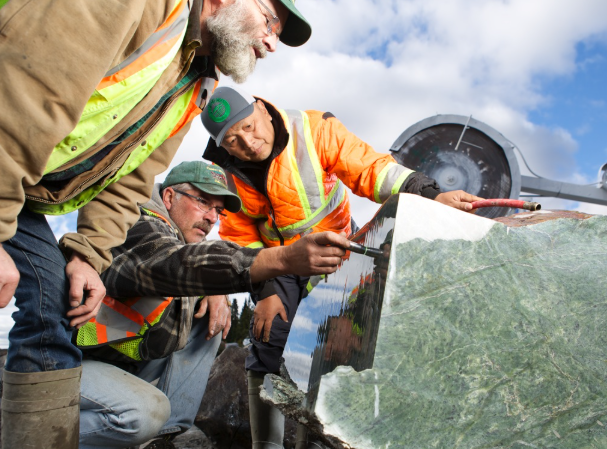
Working with British Columbia nephrite is a monumental undertaking that begins long before a carving burr ever touches the stone. Because BC jade is typically harvested in massive boulders—some weighing over 20 tons—the initial stage is a feat of industrial engineering. Unlike other jade sources where you might work with small river cobbles, BC jade requires Diamond Wire Saws or massive 36-inch to 72-inch circular saws just to get to a workable “blank.” A unique challenge with BC jade is the internal “stress” held within the boulders; because they were forged under tectonic pressure, the stone can occasionally “pop” or crack when the first major cut is made, releasing millions of years of stored energy. The master lapidary must listen to the saw; a change in pitch can signal a hidden fracture or a change in density. This “slabbing” phase is the ultimate moment of truth, where the artist discovers if the $50,000 boulder they just bought is a world-class emerald or a “shatter-box” of internal fractures.
Once the stone is slabbed into manageable “blanks,” the transition to artistry begins with Subtractive Grinding. Because BC nephrite is composed of interlocking fibers that are woven like a high-density fabric, it cannot be chiseled or flaked; it must be ground away atom by atom using diamond-bonded abrasives. For the “average user” to understand the scale of work: to carve a standard 12-inch salmon sculpture from a BC jade block, an artist may have to remove 15 pounds of solid stone using nothing but grinding wheels and water. This stage is incredibly physically demanding and requires constant water cooling. If the stone gets too hot, the water will turn to steam and the jade will “bruise,” creating white, opaque spots that ruin the deep green transparency. The artist uses a sequence of diamond wheels, starting at a brutal 60-grit to “hog” off material, moving slowly up to 220-grit to establish the final, smooth silhouette of the piece.
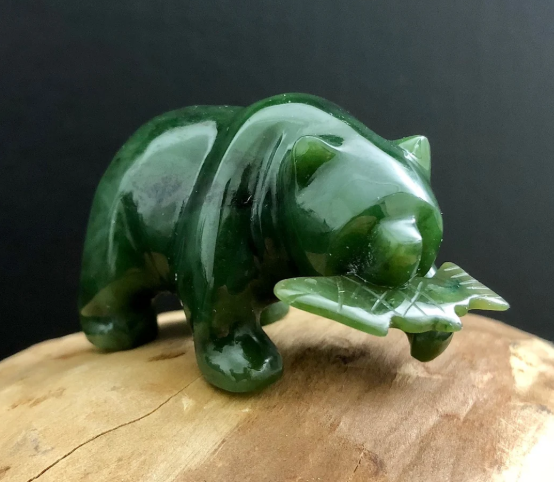
The detailing phase is where BC jade truly shows its strength. Because the fibers are so tightly interwoven, you can carve “impossible” details that would shatter in marble or even glass. Artists use high-speed Flexible Shaft tools (similar to a heavy-duty dental drill) with diamond burrs to etch fine lines, such as the scales of a fish or the delicate features of a First Nations-style mask. A specific “BC Secret” for carving is the use of Plated Diamond Burrs for roughing and Sintered Diamond Burrs for finishing. Sintered burrs have diamond particles embedded all the way through the metal, ensuring that as the tool wears down, it stays sharp. This allows the artist to maintain “surgical” precision over hours of carving. During this stage, the artist is constantly “reading” the light through the stone, carving thinner in certain areas to create a “glow” that highlights the muscle structure of an animal or the drapery of a figure.
The polishing of BC jade is a seven-to-ten stage marathon that separates the amateurs from the masters. After the carving is finished, the stone is dull and grey. The artist must move through a grueling sequence of Diamond Sanding—usually 325, 600, 1200, and 3000 grit. The goal is to remove every single scratch from the previous stage; if you miss one 600-grit scratch and move to the 1200, that scratch will become a glaring “scar” on the finished work. A major hurdle with BC jade is the “Orange Peel” effect, where the surface becomes bumpy and uneven. This happens if the artist dwells too long in one spot or uses too much heat. To combat this, the stone must be kept in constant motion, moving in “figure-eight” patterns to ensure the wear is perfectly even across the surface. This sanding phase is often done with specialized “Nova” wheels or diamond-impregnated belts that provide a soft, cushioned touch to the stone.
The final “Imperial Polish” is achieved through a combination of chemistry and friction. For BC nephrite, the industry standard is a high-speed buff using Chrome Oxide (Green Rouge) on a leather or felt wheel. However, for the highest-end museum pieces, carvers often use a 50,000 to 100,000-mesh Diamond Paste. The result is a surface that is so smooth it feels “liquid” or “oily” to the touch—a tactile sensation unique to high-quality nephrite. Once the polish is complete, the stone is often “sealed” with a light application of natural wax to protect the surface from finger oils. The final result of this 2,500-word process is a treasure that is practically immortal. A BC jade carving finished today will look exactly the same 1,000 years from now, carrying the vibrant green spirit of the Canadian wilderness into the deep future.